Medieval village or fleeting tourist stop? You sense the difference the moment you arrive in San Lorenzo in Banale: there are those who drive past on the valley floor along the Sarca, and those who climb up to the stone houses, park the car and walk.
This article is for the second sort. For those who want to understand what has made this village one of the Borghi più Belli d’Italia — not because some committee said so, but for specific reasons rooted in centuries of history.
San Lorenzo in Banale medieval village: where this place comes from
The name “Banale” is not an affectionate nickname: it refers to the ancient Comunità di Valle del Bleggio e Banale, the territory of the Giudicarie Esteriori that for centuries had its own semi-autonomous communal organisation under the prince-bishops of Trento. San Lorenzo was the administrative and spiritual centre of that community, and the structure of the village still makes this plain.
The earliest documented traces of the settlement date to the early Middle Ages, though the site was inhabited long before that. Its position on a natural terrace between the Valle del Sarca and the slopes of the Paganella offered visibility over the valley floor and natural protection — two qualities that in medieval times were worth as much as a water supply.
The parish church of San Lorenzo Martire, which presides over the centre of the village, retains Romanesque elements in its foundations and has been altered over the centuries, as have almost all the churches in these valleys. It is not a monument standing apart: it is the focal point around which village life has been built for generations.
The stones of the historic centre say more than any guidebook
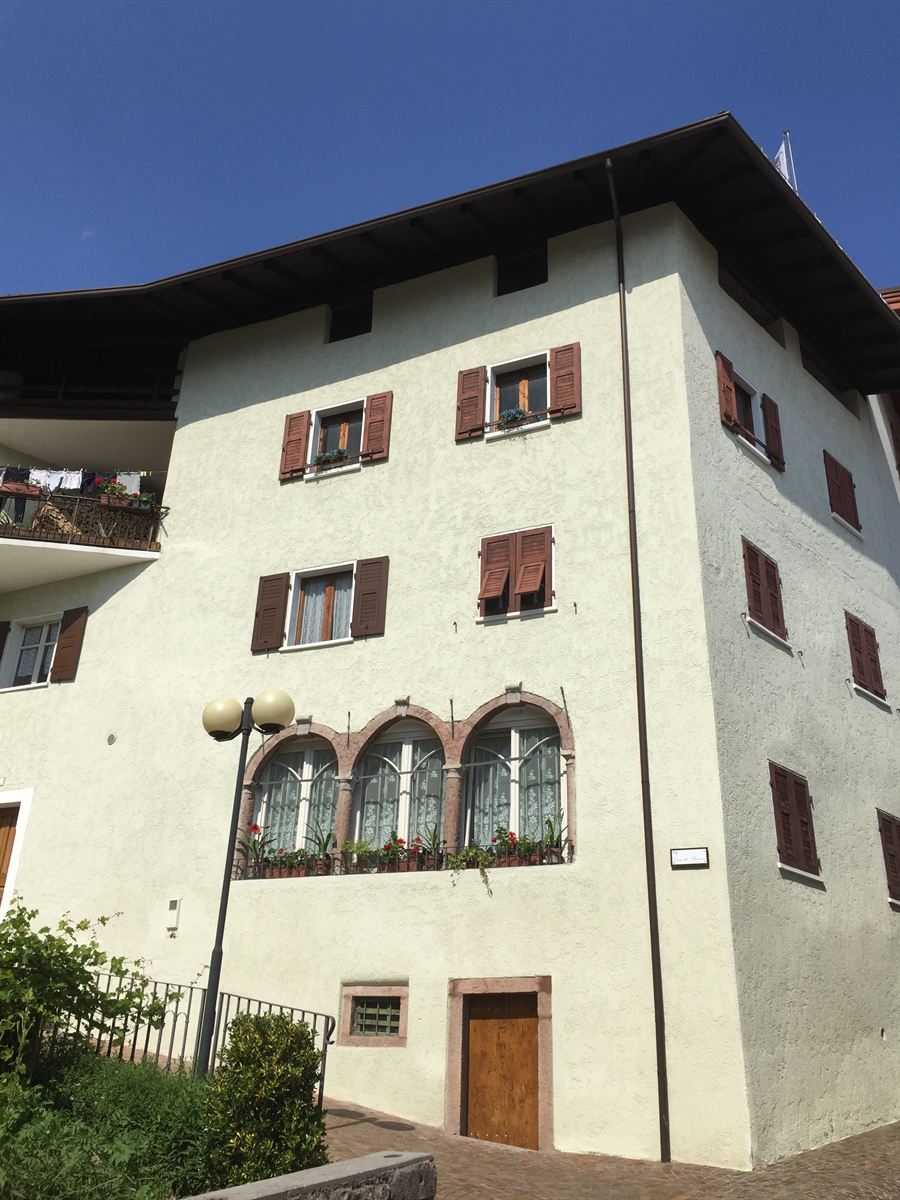
What strikes you as you walk through the streets of San Lorenzo in Banale is not a single grand building but the coherence of the whole. The houses in local limestone, the arched doorways, the loggias, the half-enclosed courtyards: everything speaks of a rural building tradition that followed precise rules, shaped by the climate, the available materials and a shared understanding of communal space that is hard to imagine today.
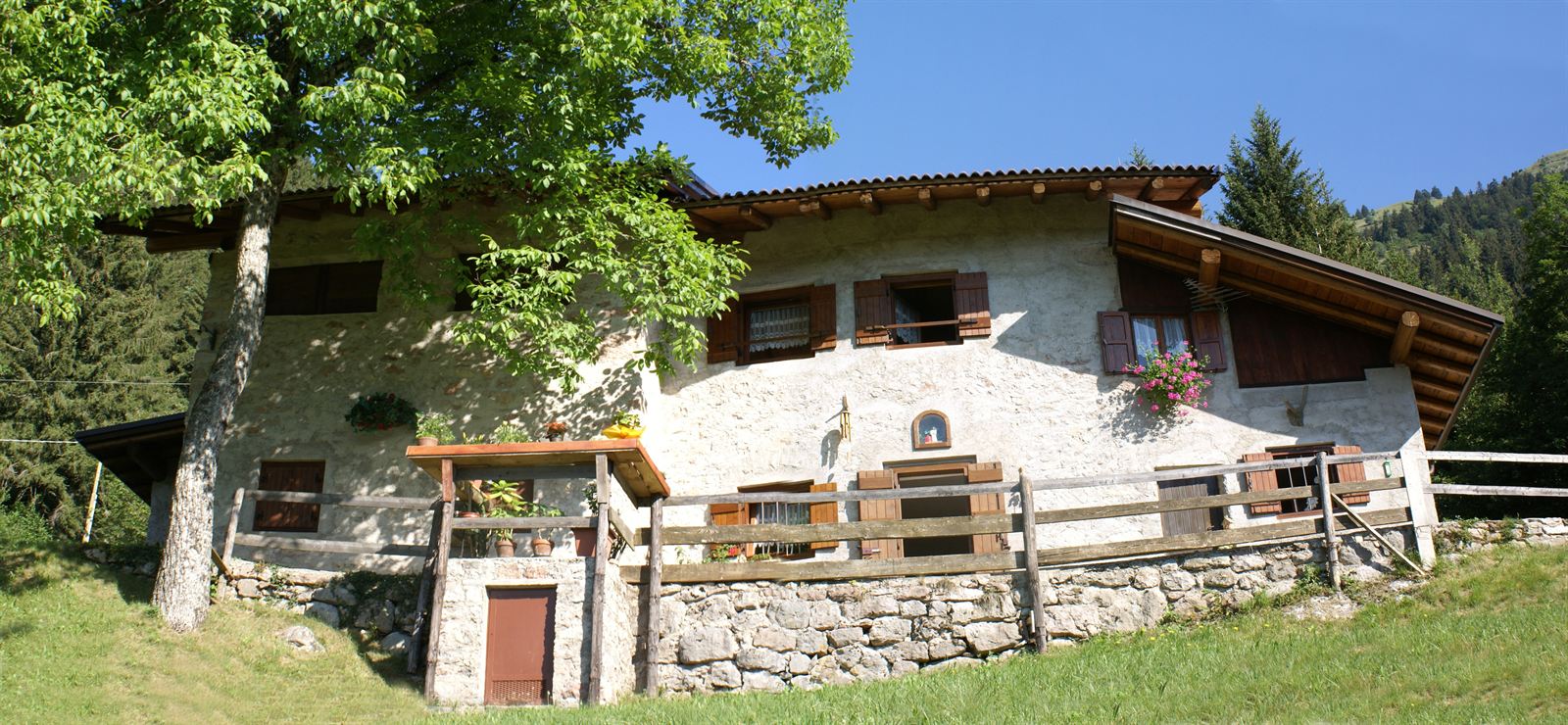
The farmsteads and courtyards were productive units as much as homes. The family, the livestock, the hay, the tools: everything coexisted in spaces designed according to a rigorous functional logic. Haylofts raised on stone pillars kept fodder clear of ground moisture. South-facing loggias made the most of winter sunshine. Nothing was decorative: everything had a purpose.
Walking through the historic centre today means reading those solutions in the surviving architecture, even where time and renovation have left their mark. You don’t need to be an architect: you just need to slow down.
The Borghi più Belli d’Italia recognition: what it actually means
San Lorenzo in Banale belongs to the Borghi più Belli d’Italia network, the association that since 2001 has selected small Italian historic centres on the basis of precise criteria: the integrity of the historic urban fabric, architectural quality, the care given to public spaces, and the vitality of the local community.
That last point is the most underrated and the most important. A village can have beautiful stonework and nobody actually living there. San Lorenzo in Banale is not an open-air museum: it is an inhabited village, with its own businesses, its seasons, its rhythms. The recognition reflects a balance that is difficult to maintain — not a permanent achievement.
Within Trentino, San Lorenzo shares this status with only a handful of other places. Within the Giudicarie, it is probably the most legible and intact historic centre remaining, after decades in which many comparable villages underwent heavy-handed private development.
The community that kept the village alive
No village survives through inertia. Behind San Lorenzo in Banale there is a community that has made deliberate choices over time, not always straightforward ones. Maintaining stone houses costs more than building in concrete. Preserving doorways and loggias requires craftspeople who know those materials — and today they are few.
The Comunità delle Regole — an ancient form of collective land management widespread in the valleys of Trentino — has played a historic role in sustaining a shared sense of ownership over the village’s resources and spaces. This is not folklore: it is a legal institution with medieval roots that in some Alpine valleys has remained operational to this day, adapting to national law while preserving its essential character.
The village is now part of the municipality of San Lorenzo Dorsino, formed in 2016 through the merger with Dorsino. A relatively recent administrative union bringing together distinct but geographically close communities, each with its own identity. San Lorenzo remains the main historic centre — the place where history can still be read in the stone.
When to visit, and in what frame of mind
San Lorenzo in Banale changes considerably with the seasons, which is good news for anyone who comes back more than once. In summer the village is lively: events, the weekly market, people in the square in the evening. In winter it falls almost silent, and that quiet has a weight of its own — the stones take on a different colour under snow, and the lights in the houses give you a clearer sense of what life here was like before tourism arrived.
Spring brings flowers to the balconies and autumn brings colour to the woods behind the village. There is no wrong season, only a wrong way to visit: rushing through, not stopping, not talking to anyone.
For information on events and local initiatives, the point of reference is Visit San Lorenzo Dorsino, which keeps an updated calendar of what’s on.
—
If you want to take San Lorenzo in Banale at the pace it deserves, staying in the village or in the nearby woods makes a real difference. Casa dei Pariani is an apartment in the heart of the village, with the historic centre right outside the door. Masadega dei Pariani is a mountain hut in the woods, a short walk away, for those who want more quiet and more nature. Two options, same territory: choose the one that suits you best.